

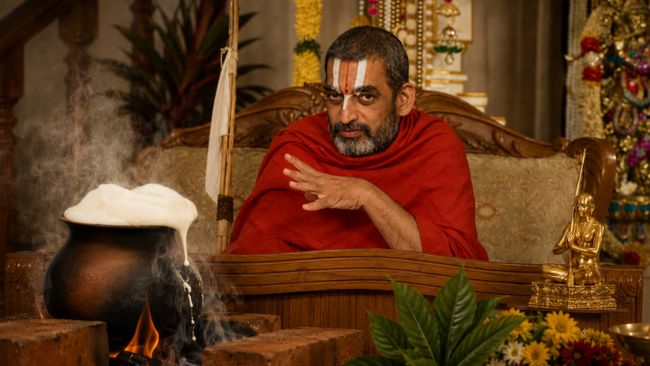
Why Does Milk ‘Rise in Anger’ on the Fire?
It was a calm early morning. Milk, mixed with a little water, sat quietly on the stove. As the water slowly evaporated, the milk sensed the change. A gentle anger seemed to rise within it. It swelled and climbed upward as if trying to put the very flame that caused its separation from the evaporating water.
This is how God feels when a devotee is pulled away from Him.
Wait a minute—does God have feelings?
Yes. The Vedas describe God as gunavaan, which literally means “one with qualities.” At the same time, they describe Him as nirguna, which literally means “without qualities.” Sounds contradictory! This is where the guidance of the Acharyas helps us understand.
Jagadguru Ramanujacharya explained that everything the Vedas say is true, even though they seem contradictory. He explained that in this context, guna refers to auspicious qualities and nirguna means one without any negative qualities. Thus, God possesses every divine supreme quality and is completely free from every undesirable quality.
But is sadness or anger over separation from a loved one an auspicious quality in God?

Let’s examine the facts lied down in Vedas about God’s qualities. Among all divine qualities, the scriptures celebrate the quality sauseelyam, God’s loving accessibility and warmth toward all beings.
seelam is defined as mahathaha mandaissaha neerandhre:na samsle:shaha
the effortless mingling of the great with the ordinary. It is like water blending seamlessly with more water, or milk mixing naturally with water, without any barrier or separation. The great one does not even think that it is doing any favor to the ordinary. This quality is called sauseelyam, or suseelatha.
Because He loves so deeply, separation brings pain. However, this pain is not selfish or narrow. It is the compassion of One who longs for the soul to return to its true home. Not every pain is inauspicious; when it exists to remove a greater suffering, it becomes sacred.
But, the Bhagavad Githa says God loves everyone equally, then how can He punish those who may have caused the separation?
samo:ham sarvabhu:the:shu
na me: dve:shyo:sthi na priyaha | 9.29
All beings are equal to Me; I neither favour anyone nor hate anyone.
The Srimad Ramayanam gives a beautiful answer. Ravana abducted Mother Sita and refused every chance to correct his mistake, even when Rama promised forgiveness. In the end, he faced the consequences of his choices. Vibhishana, however, experienced Rama’s grace. God’s love is equal for all, but the question is whether you sought His grace. This is explained in the same verse in the next two lines.
ye: bhajanthi thu ma:m bhakthya:
mayi the: the:su cha:py aham || 9.29
Those who desire Me, I go above and beyond to protect them – granting supreme privileges and access even if they are ineligible or unqualified.
Anyone who longs to know, love, and serve God experiences His sauseelyam. Such devotion towards Him alone is the qualification. Guha, Sabari, and Jatayu stand as beautiful examples of this grace. Rama went as far as granting ultimate liberation to Jatayu, i.e. the entry into Vaikunta Loka, the abode of Lord Srimannarayana.
Do you wish to be a devotee? You will experience God’s indescribable love, warmth and care, no matter where you are or what body you are in—like the milk that rose against the fire for the separated water, like Rama who rose against Ravana for Mother Sita.
Do you not wish to? He will still guide your journey, granting suitable bodies one after another through a cycle of births and deaths, according to the karma you accumulate along the way.
The choice is yours.
– From the teachings of HH Chinna Jeeyar Swamiji
– May 13th, 2026 delivered at BG Recording session, Bhagavad Githa, chapter 9 verse 29
10 Comments
JăyăŠřĕĕmåňŇááŕááýåňă!!!
Jai sreeman narayana!!!
Adiyen Dasoham
💐💐💐🙏🙏🙏🤚🙂👍❤️🌻🌻🌻
Jai sreeman narayana!!!
Adiyen Dasoham
Jai Srimannarayana !
Thank you so much for sharing Wisdom
Jai Srimannarayana! Beautiful explanation. Can we also interpret nirguna means one beyond thri-gunas (Sattava, Rajas & Tamo) gunas as Lord is in Shudha-Sattava guna (Pure goodness)?
Jai Srimannarayana, One who is beyond gunas is guna atheetha. The word Nirguna means one who does not have gunas. Whereas, Veda also says God is gunavaan. Hence, to correlate the ‘conflicting’ meanings but keeping intact Sanskrit grammar, nirguna is explained as one who does not have undesired/harmful/detrimental qualities. Hope this clarifies. Jai Srimannarayana
How beautifully explained and yet very simple to understand. 🙏
Adiyen ramanuja dasa
Super