

Want to be protected? Here’s how…
If you believe in someone as the Supreme, doesn’t that belief naturally carry the expectation of protection? For many, faith in a higher power brings with it the silent hope that this power will protect and shield them from harm. It’s almost instinctive — to trust is to hope for safety.
Let’s call this Category A or Phase A.


But there are rare, great souls who go beyond this. They do not question the ways of the Supreme, nor do they seek protection or reward. Their trust is so complete that they accept whatever comes — joy or sorrow — as divine will. For them, every experience is meaningful, every moment sacred, and every outcome, good.
Let’s call this Category B or Phase B.
And then, there is an even rarer category. For them, the greatest danger is not worldly suffering, but separation — any distance, in thought or feeling, from the Supreme Divine. They do not pray for protection from pain or loss, but for one thing only: that they may never be separated from Him — not mentally, not physically, not at any level of their being.
Let’s call this Category C or Phase C.
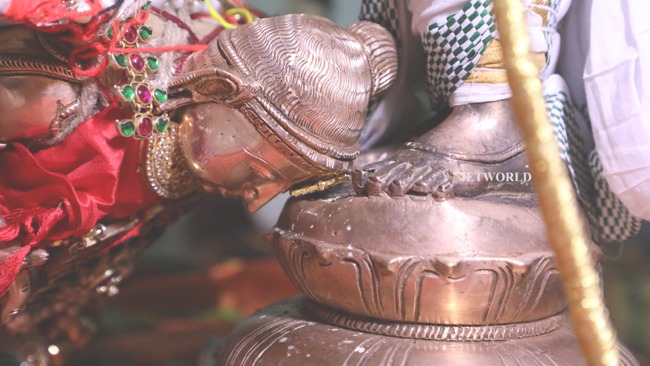
Most people belong to Category A. Some great souls, like Prahlada, exemplify Category B — surrendering completely to divine will, even in adversity. Others, like Nammalwar, embody Category C, where the longing for uninterrupted union with the Divine surpasses all other concerns.
If you find yourself in Category A, it can be deeply helpful to understand how God protects you. Without this understanding, you may fail to recognize His hand in your life, mistakenly feel abandoned, and be tempted to seek misguided paths. True knowledge brings clarity — and clarity strengthens faith.
How does God protect a seeker?
It is through practicing the mantra that speaks of God — His nature, form, qualities, and all that He is — that the seeker connects with Him and is protected by God.
manana:th thra:yathe: ithi manthraha
mantra is that which protects the one practicing it
Protection here means ishta pra:pthi, anishta nivrutthi – granting what is desired and clearing what is undesired for you.
How does a mantra work on the seeker/practitioner?
There are two methods that a seeker can apply.
- Sabda sakthi, the divine power generated by the sound of the mantra, i.e the combination of the letters
- Arttha sakthi, the divine power that arises from understanding the meaning of the mantra
Sabda sakthi
You may be familiar with a cycle dynamo — electricity is generated as you pedal. Similarly, the power of the mantra emerges through a structured and continuous process.

To fully benefit from the sabda sakti (power of sound) of the mantra:
One must perform japa (mantra repetition) a prescribed number of times — for example, 100,000 (1 lakh) repetitions.
One must then perform a homa (fire ritual) using the svahakara (offering with “svaha”) 10,000 times, which is one-tenth of the japa count.
Next, one must perform tarpana (ritual offering to ancestors and sages) 1,000 times, which is one-tenth of the homa count.
After that, one should offer puṣpanjali (flower offerings) 100 times, which is one-tenth of the tarpana count.
Finally, one should offer a meal to 10 brahmaṇas, which is one-tenth of the puṣpāñjali count.
The protective power of the mantra stays with the seeker for a period of time time, if everything is done properly. When it fades, the process must be repeated to regain its effect.
Arttha sakthi
The second method is through understanding built on the foundation of devotion and love. The knowledge embedded in the mantra, must be received through an Acharya. An Acharya is one who first grasps the truth, lives it, and then enables sishyas (students) to follow the same.

When the seeker truly understands the meaning of the mantra and holds it in the heart — with deep love for the Lord revealed through it, and with unwavering faith in both the Acharya and the mantra itself — the mantra becomes a constant protector. It remains ever-present, at all times, 24/7. It is as though one is directly plugged into the source, with no need to repeatedly regenerate the connection.

The Ashtakshari Mantra consists of eight letters. It is composed of three words: om, namaḥ, and narayana. Om itself contains three letters — a, u, ma. Namah is na + maḥ, meaning “not for me.” Narayanaaya is a combination of Narayana and aaya. All of these constructs are explained with the help of Vyakarana Sasthra (science of grammar). Each letter is a rekha vinnyasam, diagrammatic arrangement, of a specific divine power/activity/reality.
How does understanding the mantra protect a seeker?
Understanding the mantra — with the guidance of an Acharya — corrects our perception, understanding, and thinking about ourselves, the world, our actions, and the how, what, and why behind everything we do.
A lack of proper knowledge in these areas leads to six types of mental distortions or “diseases” in our thought process. The understanding of each part of the mantra can eradicate these inner afflictions. This is beautifully described in Verse 4 of the Ashtasloki, composed by the great sage Parasara Bhattar.
de:ha:saktha: a:thmabuddhiryadi bhavathi padam sa:dhu vidya:thruthi:yam
sva:thantrya:ndho: yadisya:thpratthama mitharase:shathvadhi:sche:dvithi:yam
a:thmathra:nomukhe:schannama ithi padam ba:ndhava:bha:salo:laha
sabdam na:ra:yana:khyam vishayachapala dhi:sche:thathurdhi:m prapannaha
Ashtakshari Mantra is for those who believe that God is the Supreme Power and have fully surrendered to Him. Such individuals are called prapannas — and is meant to help them with remedy for the six diseases:
| De:ha:saktha:thma buddhi |
Mistaking the body for the self
Thinking that the body and the soul (yourself) are one and the same and acting/reacting accordingly in life.
Remedy: Understanding the letter ‘ma’ in the mantra, which refers to the jivatma (individual soul) helps one learn about the nature of the self, and helps distinguish it from the body.

| Sva:thanthrya:ndhatha |
| Itharase:shathva dhi:thvam |
Believing you belong to someone or something else
Thinking you exist for the sake of others or the world, not for the Supreme.
Remedy: Understanding the letter ‘u’, meaning “only for,” indicates that you exist solely for the purpose of Narayana.
| A:tma thra:na unmukhatha |
Belief in self-protection
Thinking that you can save or protect yourself through your own efforts.
Remedy: Understanding the word ‘namah’, which means “not for myself,” shows that you are not your own protector — protection comes from the Lord.
| Ba:ndha:va:bha:sa lo:latha |
Dependence on worldly relationships
Believing that family or bodily relations can save or protect you.
Remedy: Understanding the word ‘Narayana’, indicating that Lord alone is your true saviour and protector.

| Ba:ndha:va:bha:sa lo:latha |

| Vishaya cha:palya:dhi sakthatha |
Attachment to sensory pleasures
Desiring pleasures from material objects, activities, or other beings.
Remedy: Understanding the word ‘aaya’ in Narayanaya, meaning “for [Narayana],” reminds us that we exist only for Narayana. When the mind develops true love and passion for serving the Eternal Reality, it no longer chases fleeting worldly pleasures.
Why must a mantra be taught? Can I not just call on God in my own way?
Athma, Paramathma, and other such truths are invisible realities. Trying to discover them alone is like walking into a dark, unfamiliar forest — filled with unknown challenges. That’s where an Acharya — a brahmave:tta or brahmana — becomes essential to guide and protect the seeker.
daiva:dhi:nam jagath sarvam, mantra:dhinam thu daivatam
The entire universe is under the control of Bhagava:n
Bhagava:n, in turn, obeys the manthra
than mantram bra:hmanadhinam, bramhano: mama de:vatha
Mantra is under the care of Bra:mhana
Therefore, Bra:mhana is the protector here on Earth
Who is a Bra:mhana?
A Bra:mhaṇa is one who lives with Bramha as his upiri — breath. That is, one who lives with Bhagavan as his prana, his very life force — free from layers of ignorance and ahankara. In essence, a Bra:mhana is not defined by birth alone, but by a life of devotion and practice.
bramha anathi ithi bra:mhanah
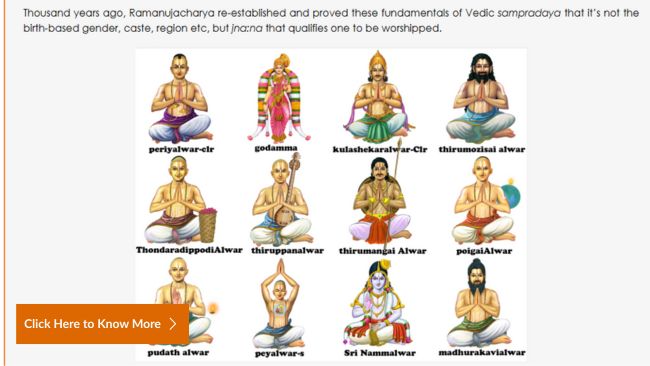
It is only with such a Bra:hmana, such as an Acharya that the mantra resides. And that is the mantra that truly protects the seeker.
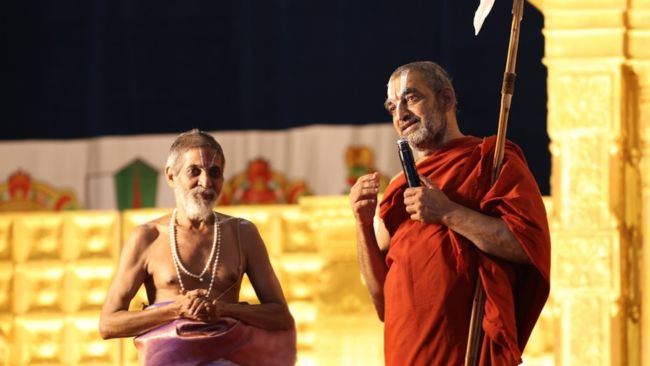
– From the teachings of HH Chinna Jeeyar Swamiji
24th, 25th, and 26th Aug 2025
One Comment
జై శ్రీమన్నారాయణ అడియెన్ రామానుజ దాసిని అసమత్ గురుభ్యోనమః🙇♀️